
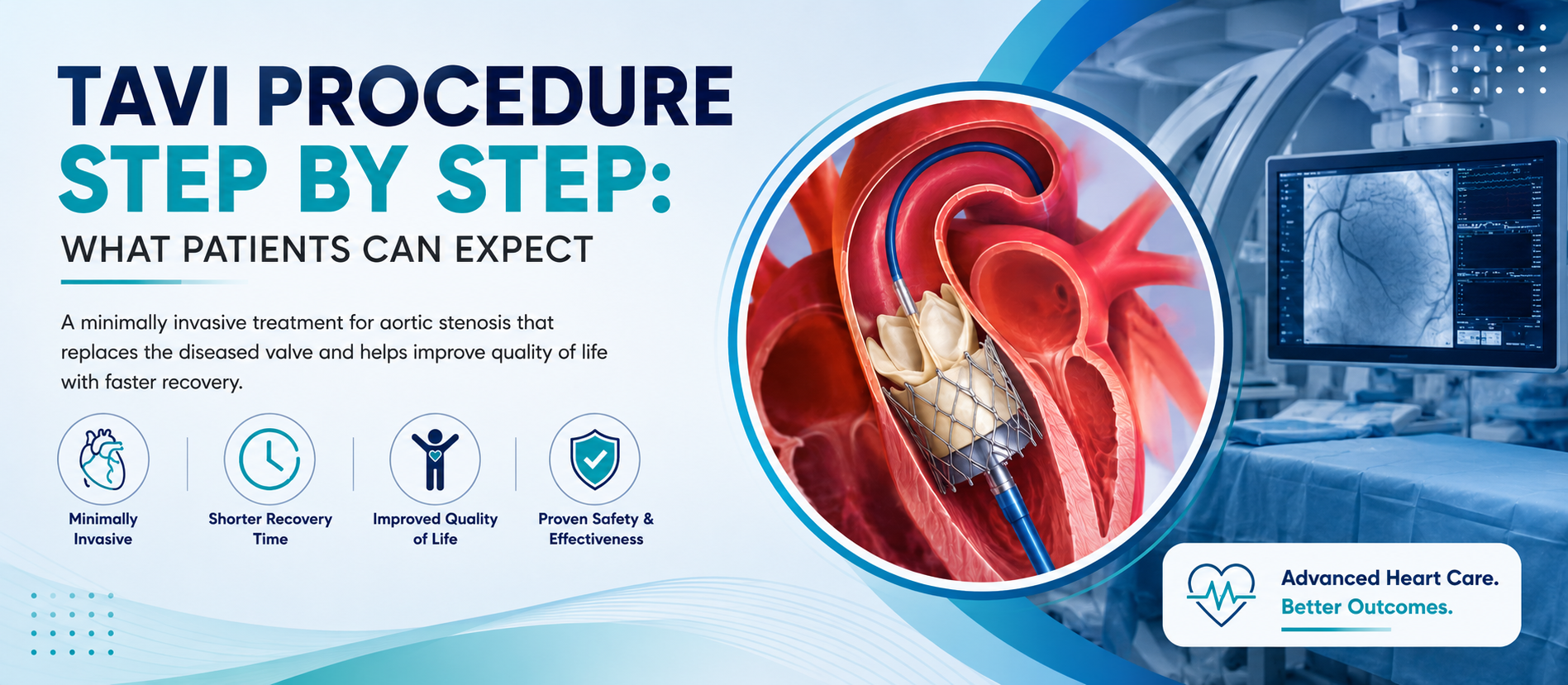
Aortic stenosis is a condition in which the aortic valve becomes narrowed, making it harder for the heart to pump blood efficiently. As the condition progresses, patients may experience breathlessness, chest discomfort, fatigue, dizziness or fainting. For selected patients with significant aortic stenosis, Transcatheter Aortic Valve Implantation (TAVI) can provide an alternative to traditional open-heart valve surgery.
If you are searching for the Best cardiologist in Ghaziabad, or an experienced interventional cardiologist in Max Hospital Vaishali, understanding what happens during TAVI can help you approach treatment with greater confidence.
Dr. Vivek Kumar, Director – Interventional Cardiology & Head of the Structural Heart Program at Max Super Speciality Hospital, Vaishali, has a special interest in structural heart interventions including TAVI. His training includes TAVI and MitraClip preceptorship at The Mount Sinai Hospital, New York, as well as international training in structural heart interventions at Cleveland Clinic, USA.
What Is TAVI?
TAVI, also known as TAVR (Transcatheter Aortic Valve Replacement), is a minimally invasive procedure used to replace a diseased aortic valve.
Unlike conventional valve replacement surgery, the damaged valve does not usually need to be surgically removed. Instead, a replacement valve is delivered through a thin catheter and positioned inside the existing aortic valve. The new valve then takes over the job of regulating blood flow from the heart to the body.
TAVI is not appropriate for every patient. A specialised heart team evaluates the patient’s symptoms, overall health, heart anatomy and blood vessels before deciding whether TAVI is the most suitable treatment.
TAVI Procedure: Step-by-Step
Step 1: Comprehensive TAVI Evaluation
Before the procedure, the cardiology team performs a detailed assessment.
This may include:
- Medical history and physical examination
- Echocardiography
- CT scan of the heart and blood vessels
- ECG
- Blood tests
- Coronary angiography when required
- Assessment of the arteries that will be used to deliver the new valve
These investigations help the heart team determine whether TAVI is appropriate and identify the safest route for placing the new valve.
Step 2: Preparing for the Procedure
Once TAVI is planned, your doctor will explain the procedure, expected benefits, possible risks and available alternatives.
You will also receive instructions regarding food, fluids and medications before the procedure. Some medicines may need to be adjusted, depending on your individual medical condition.
The anaesthesia team will also assess you. In many transfemoral TAVI procedures, a local anaesthetic with sedation may be used, although the type of anaesthesia depends on the patient’s condition and the procedural approach.
Step 3: Accessing the Blood Vessel
In many cases, the TAVI catheter is introduced through an artery in the groin, known as the transfemoral approach.
The doctor makes a small puncture or incision and introduces a thin catheter into the blood vessel. Other access routes may be considered when the femoral arteries are not suitable.
Step 4: Guiding the Catheter to the Heart
Using advanced imaging, the interventional cardiologist carefully guides the catheter through the blood vessels towards the heart and the narrowed aortic valve.
The team continuously monitors the position of the catheter and the patient’s heart throughout the procedure.
Step 5: Positioning the New Heart Valve
Once the catheter reaches the aortic valve, the replacement valve is positioned within the patient’s existing diseased valve.
Depending on the type of valve used, it may expand on its own or be expanded using a balloon. The replacement valve is designed to remain securely positioned within the existing valve.
Step 6: Checking the New Valve
After deployment, the heart team checks the position and function of the new valve.
Imaging and echocardiography may be used to confirm that the valve is opening and closing appropriately and that blood is flowing effectively through it.
If everything is satisfactory, the catheter and other equipment are carefully removed.
Step 7: Closing the Access Site
The small opening in the blood vessel is closed using a vascular closure device or another appropriate technique.
Because TAVI is performed through a catheter rather than through a large chest incision, the access wound is generally much smaller than the incision associated with traditional open-heart surgery.
What Happens Immediately After TAVI?
After the procedure, you will be monitored closely. The medical team may monitor:
- Heart rhythm
- Blood pressure
- Oxygen levels
- The catheter insertion site
- Kidney function and blood tests
- Heart valve function
Some patients may experience temporary soreness or bruising around the groin. Hospital monitoring commonly lasts around one to two days, although the duration varies according to the patient’s condition and recovery.
How Long Does TAVI Take?
The procedure itself commonly takes around one to two hours, although the total time in the procedure area can be longer depending on preparation, the patient’s anatomy and the complexity of the case.
Your cardiologist will provide an individual estimate based on your planned procedure.
What Is Recovery Like After TAVI?
Recovery after TAVI varies from patient to patient. Many people are able to leave the hospital relatively soon after the procedure if their recovery is uncomplicated.
At home, you may initially experience tiredness or mild discomfort around the access site. Your doctor will provide specific instructions about medicines, wound care, physical activity and follow-up appointments.
Some patients feel improvement in symptoms such as breathlessness and reduced exercise tolerance after successful treatment, although the pace of recovery differs between individuals.
Follow-up is important to assess your recovery and ensure that the replacement valve is functioning properly.
Are There Risks Associated With TAVI?
Like every heart procedure, TAVI carries potential risks. These can vary depending on age, overall health, heart function, blood vessel anatomy and other medical conditions.
Potential complications can include bleeding or blood vessel complications, infection, stroke, abnormal heart rhythms, kidney problems, leakage around the valve, or the need for a pacemaker in some patients.
Your heart team should discuss your individual risk profile before the procedure so that you can make an informed decision.
Who May Need TAVI?
TAVI may be considered for selected patients with significant aortic stenosis, particularly when a minimally invasive valve replacement approach is appropriate.
However, treatment decisions should not be based on age alone. The heart team considers several factors, including:
- Severity of aortic stenosis
- Symptoms
- Heart function
- Age and overall health
- Previous heart procedures
- Blood vessel anatomy
- Surgical risk
- Expected long-term benefits
- Patient preferences
A detailed evaluation is therefore essential before deciding between TAVI, surgical valve replacement or other treatment options.
Choosing the Right Heart Specialist for TAVI
TAVI is a specialised structural heart procedure that requires careful patient selection, detailed imaging, procedural expertise and coordinated follow-up.
If you are looking for the best heart specialist in Max Hospital Vaishali. it is important to consider a cardiologist’s experience in structural heart interventions and TAVI.
Dr. Vivek Kumar is Director – Interventional Cardiology & Head of the Structural Heart Program at Max Super Speciality Hospital, Vaishali. His areas of special interest include structural and complex coronary interventions, including TAVI and MitraClip.
Frequently Asked Questions About TAVI
Is TAVI open-heart surgery?
No. TAVI is a catheter-based procedure. In many cases, the replacement valve is delivered through an artery in the groin, avoiding the need for a large chest incision.
Will I be awake during TAVI?
Many transfemoral TAVI procedures are performed using local anaesthesia, sometimes with sedation. The exact anaesthesia plan depends on the individual patient and procedure.
How long will I stay in the hospital after TAVI?
An uncomplicated recovery may allow discharge after around one to two days, although some patients require a longer stay depending on their health and recovery.
How soon can I return to normal activities?
Recovery varies from person to person. Your cardiologist will advise you when to gradually resume walking, exercise, driving and other activities based on your recovery.
Is TAVI suitable for everyone with aortic stenosis?
No. A comprehensive assessment is required to determine whether TAVI is appropriate and whether another treatment would be more suitable.
Take the Next Step for Your Heart Health
A diagnosis of aortic stenosis can understandably raise many questions. Knowing how TAVI works—from pre-procedure evaluation and catheter placement to valve deployment and recovery—can make the treatment journey easier to understand.
If you have been diagnosed with aortic stenosis or are experiencing symptoms such as breathlessness, chest discomfort, dizziness or reduced exercise tolerance, consult a qualified cardiologist for an appropriate evaluation.
For patients seeking an interventional cardiologist in Max Hospital Vaishali, Dr. Vivek Kumar provides specialised care in structural heart interventions, including TAVI, at Max Super Speciality Hospital, Vaishali.
This article is intended for general educational purposes and does not replace an individual medical consultation. The suitability, benefits and risks of TAVI differ from patient to patient and should be discussed with your treating heart team.